
Building for the Next Decade: How Indonesia's Philanthropy Sector Is Laying the Groundwork for Better Elderly Care
This article has not been translated yet, so it is shown in English.
The biggest gains in social impact rarely come from a single big donation or a single successful campaign. They come from something less exciting to announce, but far more durable: shared standards, trusted networks, and institutions that know how to work with each other. That's the quiet, strategic work Indonesia's philanthropy sector is now investing in — and it's work that will shape how well the country cares for its elderly, its children, and its most vulnerable citizens for years to come.
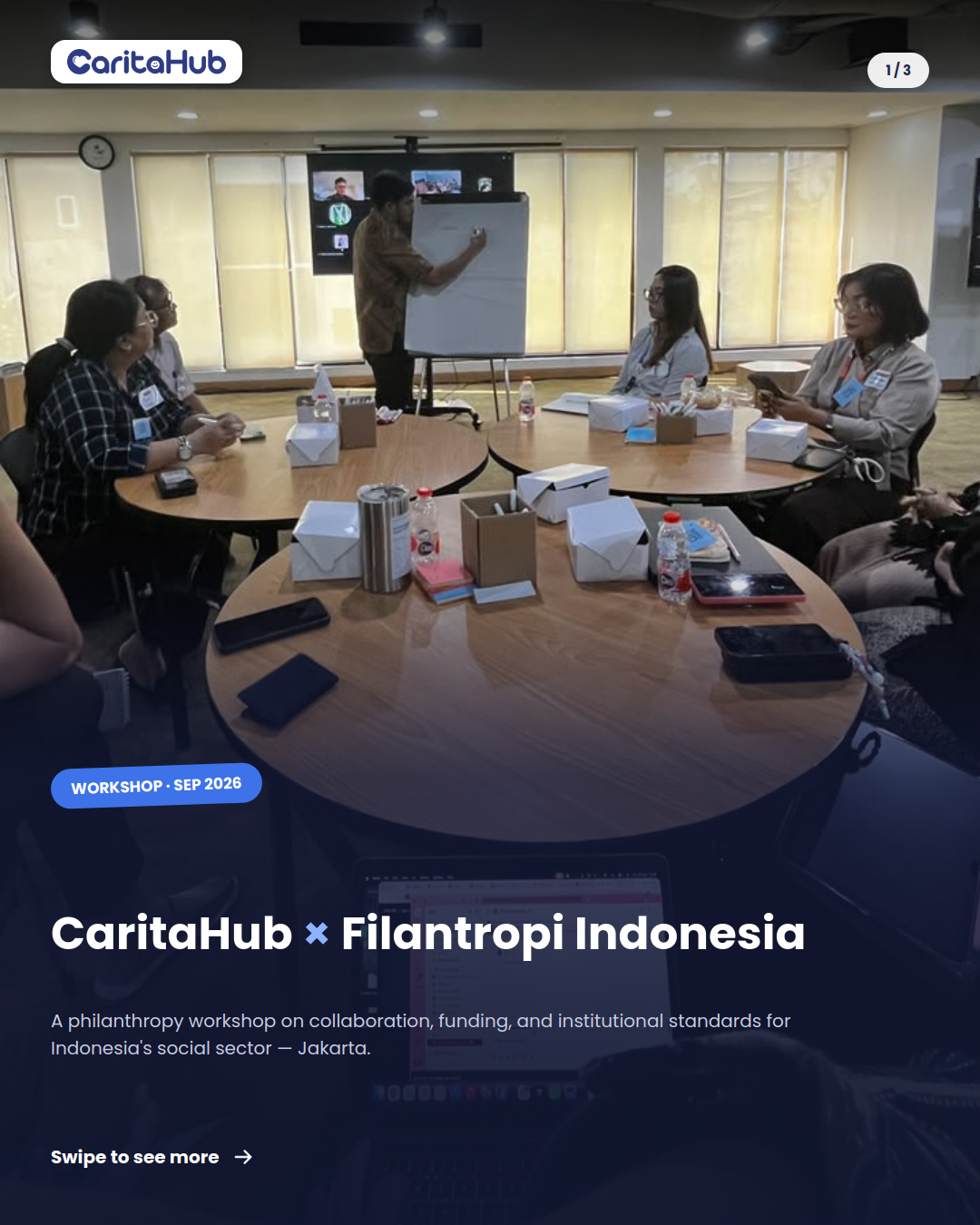
A recent workshop hosted by Filantropi Indonesia in Jakarta offered a clear window into that shift. CaritaHub was one of the organisations in the room, and what stood out wasn't any single announcement — it was how deliberately the sector is now building for the long term, rather than solving problems one grant at a time.
What the Workshop Was About
The event brought together delegates from organisations working in education, disability support, disaster response, and elderly care. It opened with remarks from Kitabisa, one of Indonesia's best-known crowdfunding platforms.
After that, the real work began: a focus group discussion, or FGD, where participants split into two groups to talk honestly about what's working, what's not, and what needs to change.
Group 1: Three Big Challenges
The first group's discussion centred on three themes that will sound familiar to almost anyone working in Indonesia's nonprofit space.
1. Collaboration and grant writing. Many organisations don't have a clear way to share what they've learned about funding — which sources are available, how to access them, and what actually works. Participants also raised a bigger question: how should funding actually be distributed to social enterprises in a way that's fair and effective?
2. Crowdfunding. Everyone agreed that crowdfunding works best when organisations communicate clearly — both when a fundraising campaign launches, and afterward, when it's time to explain exactly how the money was used. Trust breaks down fast when that second part is missing.
3. Donor matching. Before bringing a donor into a project, organisations need to be clear about what's actually needed. And donors, for their part, need a way to check whether an organisation is credible. The group agreed that Indonesia's philanthropy sector needs clearer standards — a kind of shared benchmark that helps donors trust the organisations they're supporting.
Group 2: Meeting International Standards
The second group zoomed in on a different challenge: how can Indonesian organisations become credible enough to work with international partners, not just local ones?
The answer, they agreed, often starts with something simple but overlooked: how a proposal is written. International donors and partners tend to expect a certain format, a certain level of detail, and a certain kind of evidence. Many capable Indonesian organisations are doing excellent work, but their proposals don't yet meet that bar — not because the work isn't good, but because the writing standard hasn't caught up.
Why This Matters for Elderly Care
It would be easy to read all of this as a conversation about paperwork. It isn't. Every one of these challenges — funding access, donor trust, international credibility — directly affects how well organisations can actually help people.
For elderly care specifically, this matters a lot. Indonesia's population of older adults is growing quickly, and many panti werdha, nursing homes, and home care providers are run by small, dedicated teams with limited resources. When funding is hard to access, when donors aren't sure who to trust, and when proposals don't meet international standards, the organisations working hardest to improve elderly care are often the ones that lose out.
That's exactly why CaritaHub sees itself as more than just a technology company. As a philanthropy partner, we're committed to supporting better standards of care for Indonesia's elderly — whether that's inside a panti werdha, through home care services, or in a nursing home setting. Conversations like the one in Jakarta are part of how that support gets stronger over time.
Beyond the Formal Sessions
Some of the most useful conversations at events like this happen outside the scheduled sessions. During this workshop, CaritaHub connected with delegates from organisations working in education, disability support, and disaster relief — a reminder that Indonesia's social sector, while broad, is also deeply interconnected. The challenges one organisation faces in fundraising or donor trust often look remarkably similar to another's, even if the cause is completely different.
There were also two pieces of news worth watching. Filantropi Indonesia raised the idea of exploring a collaboration with Danantara, Indonesia's sovereign wealth fund — still an early idea, but a sign of how the philanthropy sector is thinking bigger about where funding could come from. And a talkshow featuring an Australian organisation is being planned for next month, though the exact date and topic haven't been confirmed yet.
Why Elderly Care Still Needs a Louder Voice
It's worth being honest about something: at this particular workshop, elderly care wasn't the loudest issue in the room. That's understandable. Indonesia is navigating a period of economic uncertainty, the past year alone has brought a high number of natural disasters requiring urgent humanitarian response, and maternal and child welfare remains a pressing, unresolved need across much of the country. Attention, funding, and urgency naturally flow toward whichever crisis feels most immediate.
That's exactly why CaritaHub sees part of its role as being one of the louder voices for elderly care in rooms like this one — not instead of these other causes, but alongside them. Older adults living in panti werdha, receiving home care, or supported by under-resourced nursing homes rarely make headlines, and their needs are easy to postpone precisely because decline in old age is usually quiet and gradual, not sudden. If no one keeps raising elderly care as a long-term priority now, it risks being pushed further down the list every time a new emergency arrives.
The hope isn't for elderly care to overtake these other urgent issues. It's for Indonesia's philanthropy sector to grow wide enough to hold all of them at once — a sector where economic resilience, disaster response, maternal and child welfare, and the quality of life of the country's growing elderly population are all treated as long-term priorities worth protecting together.
What Comes Next
None of the challenges raised at this workshop will be solved overnight. Building shared standards, improving communication, and raising the credibility of Indonesian nonprofits on the world stage all take time — but this is exactly the kind of investment that compounds. A shared donor-trust standard built this year keeps protecting every organisation that adopts it for years afterward. A proposal-writing benchmark raised today keeps opening international doors long after the workshop is forgotten.
That is the real story here: not one meeting, but a sector deliberately building long-term infrastructure — the kind that turns individual acts of generosity into a durable system of care. When Kitabisa, Filantropi Indonesia, and organisations across education, disability, disaster response, and elderly care choose to build that infrastructure together, the entire ecosystem gets stronger — and stays stronger.
For CaritaHub, that long-term trajectory is exactly why we show up to these conversations. Better collaboration between philanthropic organisations today means a more resilient, better-resourced support system for Indonesia's elderly tomorrow — not just this year, but for the decade ahead.