
Care Scheduling Software for Homecare: The Key to Running Reliable In-Home Care
This article has not been translated yet, so it is shown in English.
Coordinating caregivers who move between different clients' homes is a fundamentally harder problem than scheduling shifts inside a single building. Every client has different needs, every caregiver has different skills and location constraints, and one last-minute change — a caregiver falls ill, a client reschedules, traffic runs long — can throw off an entire day. This is where care scheduling software for homecare earns its keep: not just building a roster, but keeping the whole operation running smoothly, traceably, and in a way families can actually trust.
This article covers what care scheduling software for homecare actually is, why the need for it is growing fast across the region, which features genuinely matter, and how a platform like CaritaHub can help homecare providers run tighter operations without losing the personal touch that care is supposed to be about.
What Is Care Scheduling Software for Homecare?
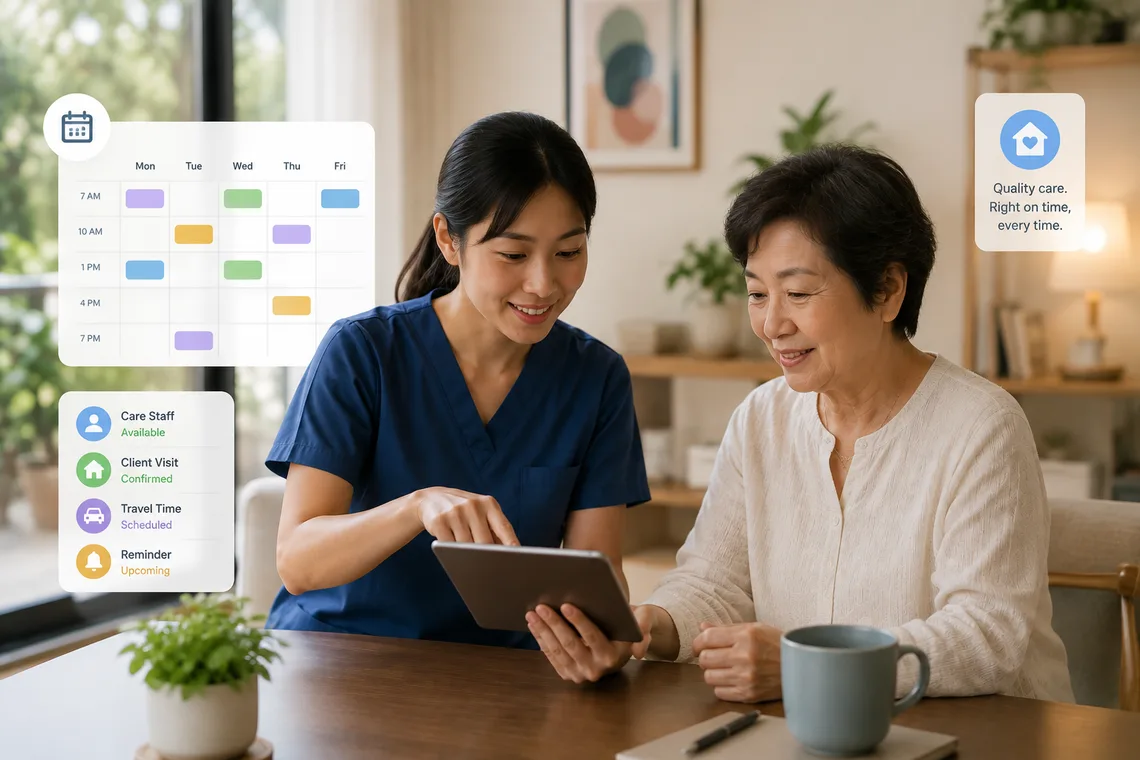
Care scheduling software for homecare is a digital system built specifically to plan, track, and coordinate caregiver visits to clients' homes. Unlike generic scheduling tools built for offices or retail shifts, this kind of system has to understand the context of care itself: matching caregiver skills to client needs, accounting for travel time between visits, surfacing a client's health history before a caregiver even arrives, and proving that a visit actually happened as scheduled.
Functionally, most care scheduling software for homecare covers: automated scheduling based on caregiver availability and location, GPS or QR-code-based check-in and check-out at each visit, digital care notes caregivers can complete on-site, real-time notifications to families when a caregiver arrives or finishes a visit, and reports that are ready for audit at any time. What separates genuinely good software from software that's merely adequate is how gracefully it handles last-minute change — because in homecare, last-minute change isn't the exception. It's Tuesday.
Why Homecare Providers Need This Now
A few forces are pushing this decision up the priority list for operators across Southeast Asia.
The region is ageing faster than its care infrastructure can absorb. Singapore's Department of Statistics reported that residents aged 65 and above reached 18.8% of the resident population in 2025, with the old-age support ratio collapsing from 7.4 working-age citizens per senior in 2010 to just 2.4 today. Indonesia's Statistics Agency (BPS) confirmed the country officially entered its "aging population" phase in 2025, with 11.97% of the population now aged 60 or above and an elderly dependency ratio of 45.05. Malaysia's DOSM recorded 12 states as officially "ageing" in 2025, and Vietnam's General Statistics Office reported that residents aged 60 and above rose to 14.5% of the population — a pace that will make Vietnam a fully "aged society" by 2036. More families across the region are choosing to keep ageing parents at home rather than move them into a facility, and that means more caregivers to schedule, track, and coordinate every single day.
Homecare schedules are inherently more fragile than facility-based ones. When a single caregiver can't make it, the ripple effect isn't confined to one shift in one building — it touches several client homes spread across different areas. Without a system that can flag conflicts and surface a replacement instantly, a coordinator can lose hours simply phoning down a list of available caregivers one by one.
Families want proof, not just reassurance. When a caregiver visits a client's home unsupervised, families reasonably want to know: did the visit actually happen, what time did the caregiver arrive and leave, and what was done during that time. Good care scheduling software for homecare answers all of this automatically, without a coordinator having to explain it manually every day.
Compliance expectations are rising here too. Just like residential facilities, homecare providers are increasingly expected to keep clean documentation — whether for internal quality control, insurance claims, or audits from corporate or hospital referral partners.
Key Features to Look for in Care Scheduling Software for Homecare
Not every scheduling tool is built the same. A few features genuinely separate a solid system from a glorified digital calendar:
- Smart, location-aware matching — the system should automatically pair the right caregiver with the right client, factoring in travel distance, not just time-slot availability.
- Real-time visit verification — GPS or QR-code check-in and check-out confirms a visit actually happened as scheduled, and cuts down on disputes over hours worked.
- Fast handling of last-minute change — the moment a caregiver cancels, the system should immediately surface who's available to cover, instead of requiring a coordinator to call down a list.
- Family-facing visibility — automatic notifications when a caregiver arrives, finishes a visit, or a schedule changes, so families don't have to call the office just to check that everything's on track.
- Audit-ready documentation — visit reports, care notes, and schedule history should be exportable on demand, not reassembled manually before every audit.
- Genuine local fit — software built for the US or European market often misses realities on the ground here: patchy internet connectivity in some areas, caregivers who may not be comfortable with complex apps, and a real need for local-language support.
This is exactly where CaritaHub is worth a closer look. The same scheduling and care-coordination engine that already supports operations across more than 40% of Singapore's Active Ageing Centres and six ASG-certified facilities in Indonesia is built on the same underlying principle homecare needs: making sure the right person is in the right place at the right time, with a record that holds up whenever someone asks. The difference is that instead of staff based in a single building, CaritaHub's scheduling engine adapts to caregivers moving between client homes — complete with real-time family notifications and documentation that's audit-ready by default.
How the Right Software Changes a Homecare Team's Day
Picture an ordinary morning at a homecare office: one caregiver messages that she's unwell, the coordinator scrambles through a spreadsheet of 15 names to find a replacement, all while fielding a call from a family asking why today's visit hasn't started. With the right care scheduling software for homecare, that entire sequence changes: the system automatically flags the conflict, suggests a replacement based on location and matching skills, and notifies the family the moment a substitute is confirmed — all within minutes, not hours.
The effect isn't just speed. A coordinator who used to spend half a day reshuffling schedules now has time for the things that actually matter — care quality, client concerns, and growing the service. Caregivers benefit too: instead of guessing at tomorrow's schedule, everything's laid out clearly in the app, along with the details they need to know about the client they're about to visit.
How to Choose the Right Care Scheduling Software for Homecare
A few practical steps are worth more than any feature list on a sales page:
- Ask for a real-scenario walkthrough, not just a standard demo — see exactly how the system handles a caregiver cancelling at the last minute.
- Test reliability under real field conditions — does it still work smoothly when a caregiver's connection drops mid-visit?
- Involve caregivers and coordinators in the trial, not just management — they're the ones who'll use it every day.
- Make sure families get visibility too, not just the internal team — this is what separates homecare that feels trustworthy from homecare that feels like a black box.
- Ask what support looks like after go-live — a system that shines in a demo is worthless if there's no one to help when a caregiver gets stuck in the field.
See What CaritaHub Can Do for Your Homecare Team
Good homecare is built on trust — a family's trust that their parent is genuinely being looked after, and a caregiver's trust that their schedule is clear and fair. The right care scheduling software for homecare is the foundation of that trust, and CaritaHub brings experience already proven across hundreds of care facilities in Singapore and Indonesia into a more flexible context: caregivers on the move, not caregivers tied to one building.
If you're running a homecare service and still relying on spreadsheets, WhatsApp groups, and back-and-forth phone calls to manage caregiver schedules, now is the moment to see what a platform built specifically for care — not generic scheduling — can do for your team.
Book a CaritaHub demo today and see firsthand how the right scheduling system can free up your team's time, give client families genuine peace of mind, and make every single caregiver visit properly logged and accountable.
Conclusion
Choosing care scheduling software for homecare isn't just about swapping a paper calendar for an app. It's about making sure every caregiver visit happens on time, every last-minute change is handled in minutes, and every family has certainty that the person they love is genuinely getting the care they were promised. With ageing trends accelerating across Southeast Asia, reliable scheduling infrastructure for homecare isn't optional anymore — it's an operational necessity.
If your team is ready to move past manual workarounds and see how the right technology can transform homecare operations, reach out to the CaritaHub team and schedule a free demo — the first step toward in-home care that's tighter, faster, and genuinely trustworthy.