
CaritaHub and Bappenas Chart a New Path for Elderly Care Technology in Indonesia
This article has not been translated yet, so it is shown in English.
Indonesia is standing at the edge of a major demographic shift. Within the next two decades, the country's population of citizens aged 60 and above is projected to grow significantly, placing new demands on families, caregivers, and the social welfare system as a whole. Against this backdrop, a recent meeting in Jakarta between CaritaHub and two senior officials from the Ministry of National Development Planning (Kementerian PPN/Bappenas) signals a growing national interest in how elderly care technology can help Indonesia prepare for this transition — not years from now, but starting today.
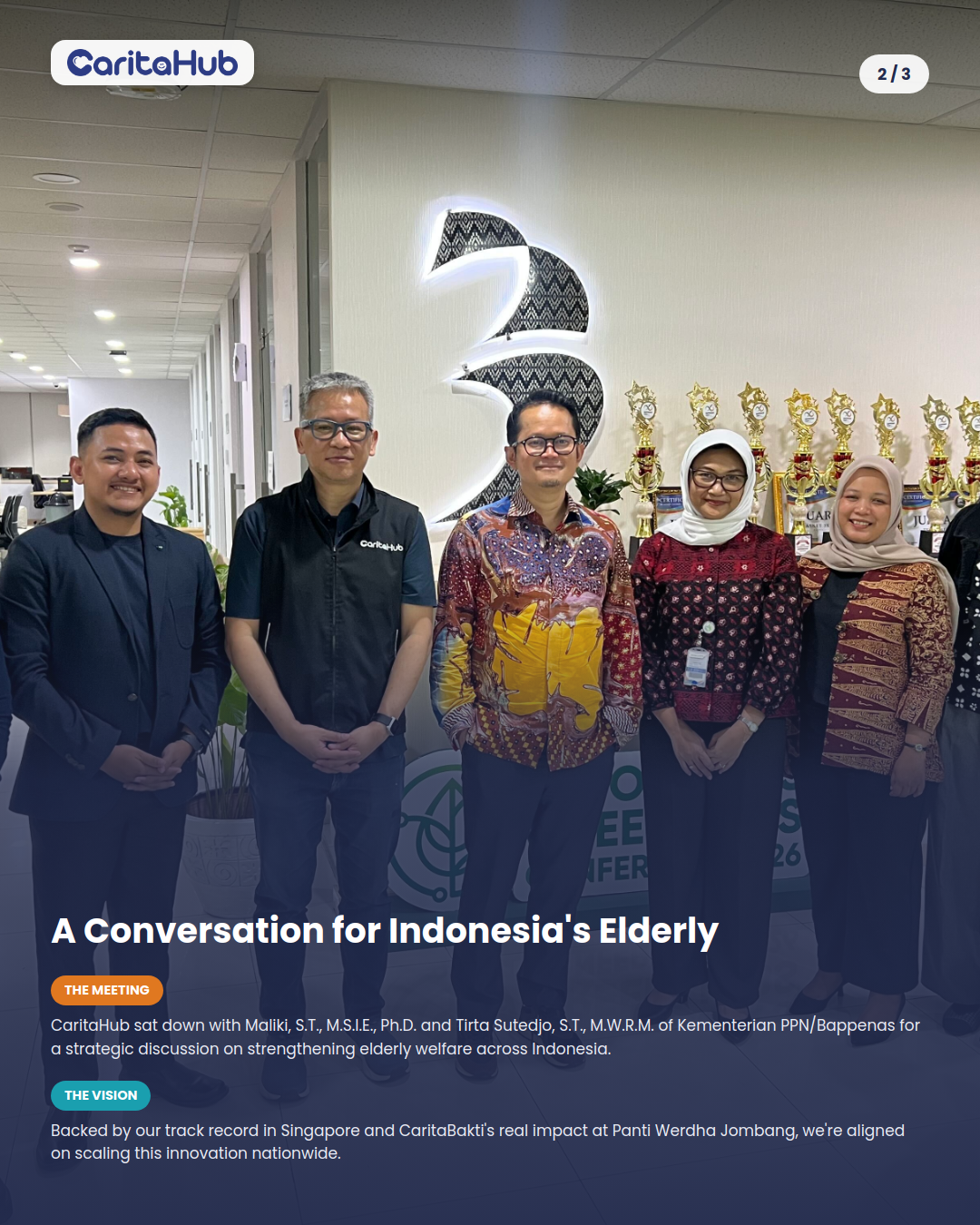
The discussion brought together the CaritaHub team with Maliki, S.T., M.S.I.E., Ph.D., Deputy for Community Empowerment, Population, and Employment, and Tirta Sutedjo, S.T., M.W.R.M., Director of Poverty Alleviation and Social Welfare at Kementerian PPN/Bappenas. The conversation centered on a question that is becoming increasingly urgent across Southeast Asia: how can AI-powered innovation help scale compassionate, consistent elderly care to communities that need it most, without waiting on infrastructure that may take years to build?
Why Elderly Care Technology Is Becoming a National Priority
Indonesia's aging population trend mirrors a pattern seen across much of Asia. As life expectancy rises and birth rates decline, the ratio of working-age citizens to elderly citizens is narrowing — a shift demographers often describe as a "silver wave." Unlike some of its neighbors, however, Indonesia is approaching this transition while still developing key parts of its social welfare and eldercare infrastructure, particularly in areas outside major cities.
This is precisely where elderly care technology has the potential to make an outsized difference. Rather than relying solely on large-scale physical infrastructure — nursing homes, hospitals, or a dramatically expanded caregiving workforce — AI-powered tools can extend the reach of existing staff and family caregivers, offering a layer of consistent, low-cost engagement that would otherwise be impossible to deliver manually to every senior in a community.
That is the exact gap CaritaHub was built to address.
Introducing Caring Voice: AI Voice Care Built for Seniors
At the center of CaritaHub's approach is Caring Voice, an AI voice companion designed specifically for outbound calls to elderly individuals. Unlike generic call-center chatbots, Caring Voice is purpose-built around the realities of elderly phone conversations: slower, more patient pacing; warm, natural-sounding voices in both English and Singapore-flavoured Mandarin; and structured, easy-to-interpret outcomes after every call.
In practice, Caring Voice typically handles two of the most common — and most time-consuming — calls that care staff make every day:
- Activity reminders — gentle, short calls confirming whether a senior plans to join an upcoming community activity, complete with logistical details like transport arrangements.
- Daily check-ins — a simple "how are you doing today?" call that listens for signs of loneliness, distress, or a change in wellbeing, and automatically flags any concerns for a human case worker to follow up on.
This second function is where the technology moves beyond simple automation and into something closer to genuine care. Rather than scripting rigid, one-way announcements, Caring Voice is designed to listen, adapt its follow-up questions based on context, and route anything unusual straight to the right person — turning a basic phone call into an early-warning system for caregivers and case workers.
Beyond the Phone Call: CaritaHub Arena and Community Engagement
Elderly care technology isn't only about individual check-ins — it's also about keeping seniors socially engaged, mentally active, and connected to their communities. This is where CaritaHub Arena comes in: a platform that turns any television into a shared, interactive game table. Residents scan a QR code with their own phone to join instantly, no app or account required, and play together live in English or Mandarin.
Beyond the obvious benefits of cognitive stimulation and social interaction, Arena solves a quieter but very real operational problem for care centres: every session is automatically logged against a resident's record, feeding directly into attendance and engagement reporting. For care centre staff, that means group activities that used to require manual sign-in sheets and coordination now generate their own structured data — freeing up time for direct, face-to-face care.
A Proven Track Record in Singapore
CaritaHub's presence in this conversation carries weight in part because its technology isn't theoretical — it is already running on the ground in Singapore, where the platform has been developed and refined specifically for Southeast Asian elderly care contexts, including local languages, dialects, and cultural norms around aging and family care.
This track record matters enormously in a policy conversation. Government stakeholders evaluating new technology for social welfare programs are, understandably, cautious about pilots that have never been tested at scale. CaritaHub's ability to point to a functioning deployment — one already certified and whitelisted as compatible with Singapore's Active Ageing Centre (AAC) IT systems — gives Indonesian policymakers a real-world reference point rather than a hypothetical pitch.
CaritaBakti: Bringing the Technology Home to Panti Werdha Jombang
Perhaps the most important part of the discussion, however, wasn't about Singapore at all — it was about Indonesia. Through its CaritaBakti initiative, CaritaHub has already begun piloting its elderly care technology domestically, at Panti Werdha Jombang, a care home in East Java.
This pilot matters for a simple reason: it demonstrates that the same voice-AI approach that works in Singapore's urban context can be adapted to Indonesian elderly care settings too — different language needs, different family structures, and different expectations around what "care" should feel like. Early engagement from residents and caregivers at Panti Werdha Jombang has given the CaritaHub team confidence that this model isn't just exportable in theory, but genuinely adaptable to Indonesian communities.
For Bappenas, a real domestic case study like CaritaBakti is far more persuasive than an international success story alone. It answers the question every government stakeholder eventually asks: does this actually work here?
What a National-Scale Vision Could Look Like
While the meeting was still at the discussion stage, the alignment between CaritaHub and Bappenas points toward a broader ambition: exploring how AI-powered elderly care tools might complement Indonesia's existing social welfare programs, rather than compete with them.
That could take several forms — from supporting Indonesia's network of Integrated Elderly Service Posts (Posyandu Lansia) with automated check-in calls, to using engagement platforms like Arena to support community-based elderly care programs already being run at the village (kalurahan) level. In every case, the underlying philosophy stays the same: technology should extend what human caregivers can already do, not attempt to replace the human relationships at the heart of elderly care.
This mirrors a broader shift happening globally. From Japan to South Korea to across Europe, governments facing similar demographic pressure have increasingly turned to eldercare technology not as a cost-cutting measure, but as a way to make limited caregiving resources go further. Indonesia's exploration of this space — informed by a working deployment in Singapore and a real pilot in Jombang — puts it in a strong position to adapt these lessons to local needs rather than starting from scratch.
Why This Conversation Matters Beyond CaritaHub
It would be easy to read this as simply a company meeting with government officials. But the significance runs deeper. Indonesia's aging population isn't a distant, abstract policy issue — it is a set of very human questions playing out in millions of households already: Who checks in on an elderly parent living alone? Who notices when a grandmother stops attending community activities? Who has the bandwidth to make that call, every single day, to every senior who might need it?
Elderly care technology, done well, doesn't answer those questions by replacing family or community — it answers them by making sure no one falls through the cracks simply because there weren't enough hours in a caregiver's day. That is the throughline connecting Caring Voice's daily check-in calls, Arena's community game nights, and CaritaBakti's on-the-ground pilot in Jombang: not one technology story, but a consistent thesis that scale and compassion don't have to be in tension with each other.
Looking Ahead
As Indonesia continues to shape its national strategy for population aging, conversations like this one — between innovators building real, deployed elderly care technology and the government bodies responsible for national development planning — will likely become more common, not less. For CaritaHub, this meeting with Bappenas represents both validation of the work already done in Singapore and Jombang, and an invitation to think seriously about what it would take to support elderly welfare at a truly national scale.
For a country preparing to support tens of millions of older citizens in the coming decades, that is exactly the kind of conversation worth having early — and worth having often.
CaritaHub is an AI-powered elderly care technology platform offering Caring Voice, an AI voice companion for outbound wellness calls, and CaritaHub Arena, a shared interactive engagement platform for care communities. Learn more at www.caritahub.com.