
Fall Prevention for the Elderly in Asia: 7 Practical Steps That Actually Work
This article has not been translated yet, so it is shown in English.
Mr. Lim, 74, slipped in the bathroom one night. Nothing broke. He got up, laughed it off, and told no one.
But something changed. He stopped walking to the morning market. He started taking the lift for a single floor. Within three months, his legs were visibly weaker, and his family only noticed when he needed to hold the wall just to stand from a chair.
Mr. Lim never fell badly. The fear of falling did the damage.
His story is common across Asia, and it points to something most people miss: fall prevention isn't only about avoiding the fall itself. It's about protecting confidence, strength, and independence. The good news is that falls are far more preventable than most families assume.
How Common Are Falls, Really?
Globally, the numbers are larger than most people expect:
- At least one in three people over 65 who live in the community fall every year, according to a major Cochrane systematic review.
- In the United States, the CDC estimates that about 1 in 4 older adults falls each year, and roughly 1 in 5 of those falls causes a serious injury such as a broken bone or head injury.
In Asia, the picture is more varied — and in some ways, more revealing.
Falls Across Asia: What the Numbers Say
A systematic review of Asian studies found that community-dwelling older adults reported falls at rates of roughly 14–34% a year (median around 18%) — lower than the 30–39% typically reported in Western countries. But those figures need careful reading. Studies in Asia use different time windows (6 months versus 12 months), different age bands, and rely heavily on self-reporting, so country-to-country comparisons are rough at best. The more consistent story across the region is in the consequences. Here is what national and regional data show:
Malaysia. The National Health and Morbidity Survey 2018 found that around 15% of people aged 60 and above had at least one fall in the previous 12 months. In institutional care, studies in Kuala Lumpur estimate 24–40% — roughly 1.5 to 2.5 times the community rate.
Singapore. Roughly one in three community-dwelling seniors aged 65+ falls at least once a year, rising to one in two above age 80, according to a review in the Singapore Medical Journal. The same review notes that falls accounted for 85% of elderly trauma cases seen in emergency departments in the SAFE study, that falls account for about 40% of injury-related deaths in Singapore, and that only about half of fallers can get up from the floor on their own. About 30% of fallers go on to fall again.
China. National injury surveillance data for 2018 put the incidence of falls among older people at 20.7%, and falls are the top cause of injury death for people aged 65 and over. An estimated 75,000 people over 70 died from falls in 2017. Among 100,551 reported fall cases in people aged 60+ in 2018, 34% resulted in fractures and nearly 25% required hospitalisation. In Chinese nursing homes, a meta-analysis of 11 studies pooled the fall rate at 32%.
Japan. Fractures and falls account for 13.0% of the primary causes of long-term care certification — the third most common cause, after dementia and stroke, according to the Ministry of Health, Labour and Welfare's 2022 survey. A nationwide claims analysis found that about 1 in 5 (20.2%) older adults with a fracture was certified as needing long-term care within a year. In care facilities, roughly 10% of residents experience a serious fall — one causing a fracture or hospital transfer — in a given year.
Thailand. The national health examination survey estimated that about 15.3% of community-dwelling older adults had fallen recently. A large study in southern Thailand found the rate climbing steeply with age: 9.5% for ages 60–69, 12.1% for 70–79, and 18.8% for those over 80.
Indonesia. In the Indonesia Family Life Survey, 12.8% of adults aged 50 and over had at least one fall-related injury over two years. A West Java study found fall prevalence of 16.5% in rural areas versus 10.7% in urban ones.
Vietnam. A nationally representative survey found 7.3% of community-dwelling older adults had fallen in the previous year, though other Vietnamese studies have reported anywhere from 15% to 51%, a reminder of how much methods vary. Among older patients hospitalised after a fall in Thai Binh province, 40.5% had fallen repeatedly in the past year, and 26.2% showed signs of psychological distress.
Three Patterns That Run Across the Region
1. Numbers differ, consequences don't. Whether the annual rate is 7% or 30%, the outcomes are consistent: fractures, hospital stays, and — as Japan's data shows — loss of independence.
2. Fear of falling is widespread. A systematic review of studies in Malaysia, Singapore, Thailand and Vietnam found fear-of-falling rates ranging from 21.6% to 88.2%, and a pooled analysis across Southeast Asia estimated about 44%. In Vietnam, community studies report 40.8–64%. This is Mr. Lim's story at population scale.
3. Many falls go unreported. Singapore clinicians describe "silent fallers" — seniors who never report a fall or seek care — and note that falls are often accepted as "part of ageing" by both patients and their families. A fall nobody knows about is a fall nobody can learn from.
Why Seniors Fall: Rarely Just One Cause
A fall is usually the final step in a chain of small, quiet changes:
- Weaker muscles and slower balance reactions — the most common underlying factor
- Medication side effects such as dizziness or drowsiness, especially when taking several medicines
- Vision and hearing changes that make obstacles harder to spot
- Blood pressure drops when standing up too quickly
- Home hazards — loose rugs, poor lighting, wet bathroom floors, uneven steps
- Footwear that is loose, worn, or slippery
Because there are many small causes, there are also many small fixes.
7 Practical Steps to Prevent Falls
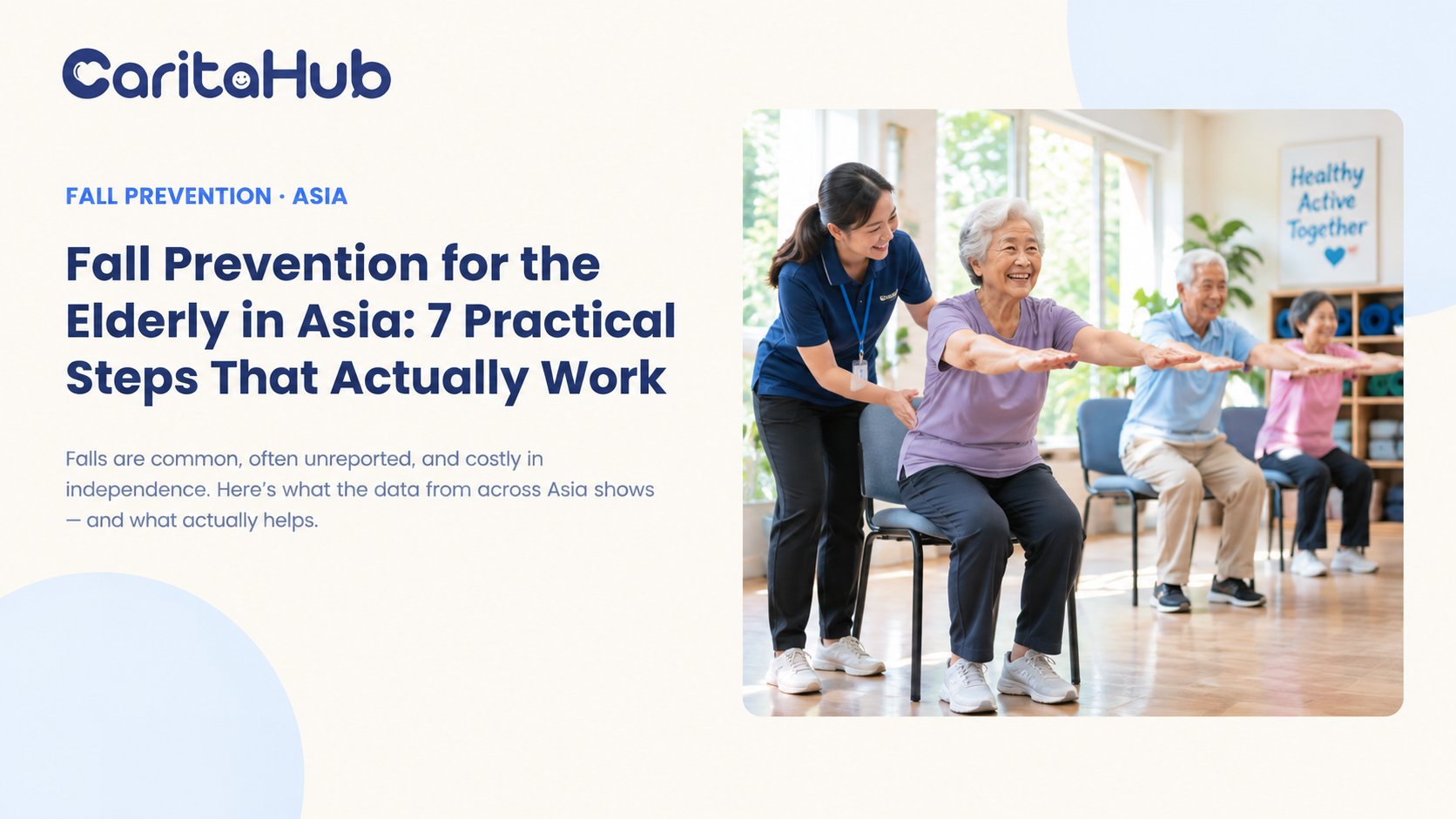
1. Build strength and balance — the single best-evidenced step. The Cochrane review found that exercise reduces the rate of falls by about 23% and the number of people who fall by about 15% (high-certainty evidence). Exercises that challenge balance — such as tai chi, standing leg-lifts, and sit-to-stand practice — and muscle strength work best. Check with a doctor or physiotherapist before starting a new programme.
2. Review medications with a doctor or pharmacist. Ask specifically: "Could any of these cause dizziness or drowsiness?" Never stop a medicine on your own — but do ask for a review at least once a year, or whenever a new medicine is added.
3. Check eyes, ears, and feet. Annual vision checks, correct glasses, and well-fitting, non-slip shoes with a firm sole are small changes with outsized impact. Avoid walking in socks or loose slippers on smooth floors.
4. Make the home safer. Remove loose rugs, add bright lighting (especially on the path from bed to bathroom at night), install grab bars and non-slip mats in the bathroom, and keep frequently used items at waist-to-shoulder height.
5. Stand up slowly. Sit on the edge of the bed for a moment before standing. Stay hydrated through the day. If your parent often feels light-headed when standing, mention it to their doctor.
6. Don't let fear shrink their world. Like Mr. Lim, many seniors respond to a near-miss by moving less — which makes muscles weaker and the next fall more likely. With roughly four in ten older Southeast Asians reporting a fear of falling, this is a common trap. Encourage safe, regular activity rather than avoidance.
7. Have a plan for the moment a fall happens. Even with the best prevention, a fall can still occur. If only half of fallers can get up alone, what happens in the minutes afterwards matters: a senior who lives alone and can't reach a phone may stay on the floor for a long time. Having a way to call for help — and for someone to be told automatically — closes that gap.
Quick Check: Is Your Parent at Higher Risk?
Tick what applies. You don't need to tick every box for it to be worth acting.
- ☐ Has fallen, or nearly fallen, in the past year (and perhaps never mentioned it)
- ☐ Uses a wall, furniture, or cane for balance at home
- ☐ Takes four or more regular medicines
- ☐ Feels dizzy when standing up
- ☐ Has stopped some activities out of fear of falling
- ☐ Lives alone, or is alone for long stretches of the day
Two or more ticks is a good reason to talk to their doctor about a fall-risk assessment.
Where Technology Genuinely Helps
Technology can't replace strength training or a safe home. But it can cover the gap that families can't: being there in the moments when no one is — and catching the "silent falls" that would otherwise go unreported.
This is the problem CaritaHub, a senior-care platform built by Weeswares, was designed around. It operates in Singapore, Indonesia and Vietnam — three of the markets in the data above — and addresses fall risk at three points:
Before a fall — spotting early signals. At Active Ageing Centres where CaritaHub runs, everyday signals such as a missed session or a concerning health reading raise an attention level for staff to review. This risk-flagging capability, called Risk Intelligence, was developed in collaboration with Tzu Chi Foundation. Strength and activity programmes — including exercise equipment used in centres — support the "build strength" step above.
During a fall — detecting it instantly. CaritaPal, a wearable device, combines fall detection with an SOS function, location, and vital-sign monitoring. If a fall occurs, the alert doesn't depend on the senior remembering to report it, or waiting for the next scheduled check-in.
After a fall — a human decides. Every alert goes to a named coordinator who decides how to respond, logged with a name and a time. The system prompts; a person decides. Family members can stay informed through a dedicated caregiver app, so the daughter three hours away isn't left guessing.
CaritaHub now runs across more than 90 Active Ageing Centres in Singapore — about 40% of the national network — and is certified compatible with Singapore's national Active Ageing Centre IT standard.
The Takeaway
Across Asia, the numbers differ, but the pattern is the same: falls are common, often unreported, and costly in independence. Fall prevention is a handful of small, consistent actions: stay strong, review medicines, check eyes and feet, fix the home, stand up slowly, stay active, and have a plan for the worst moment.
And if you take away only one thing from Mr. Lim's story, let it be this: ask your parents how they feel about walking — not just whether they've fallen. The answer is often the earliest warning sign you'll get.