
Healthy Eating for Seniors: Why Nutrition Tracking Matters, and How Technology Can Help
This article has not been translated yet, so it is shown in English.
Ask most families what they worry about most for an aging parent, and the answers tend to cluster around the visible things: a fall, a missed medication, a forgotten appointment. Few people list "what did she eat today?" near the top of that list — and yet, of all the quiet risks facing older adults, changes in appetite and nutrition are among the most common, and among the easiest to miss until they've already become a problem.
Malnutrition in older adults rarely announces itself. It doesn't usually look like a crisis. It looks like a senior who has simply stopped finishing meals, who has quietly swapped a home-cooked lunch for crackers because cooking has become tiring, or who has lost a few kilograms so gradually that nobody noticed until a check-up revealed it. By the time it's visible, the effects — fatigue, weakened immunity, slower recovery from illness, increased fall risk — are often already underway.
Why Nutritional Needs Change With Age
The nutritional needs of a 75-year-old are not the same as those of a 35-year-old, even if their diets look identical on paper. Several things shift as the body ages, and together they explain why "eating less" is so common — and so risky — among seniors.
Appetite itself tends to decline with age, partly due to a natural blunting of hunger signals, partly due to a reduced sense of taste and smell that makes food less appealing, and partly due to medications that can suppress appetite or alter how food tastes. Chewing and swallowing can become more difficult, whether from dental issues, dry mouth, or age-related changes in swallowing muscles — often quietly pushing someone toward softer, less nutritious foods simply because they're easier to manage. Digestion also slows, which can affect how efficiently the body absorbs key nutrients even when a senior is eating a reasonably balanced diet. And many older adults are managing one or more chronic conditions — diabetes, hypertension, osteoporosis, kidney disease — each of which changes what "healthy eating" actually means for that individual.
The result is a population whose nutritional needs are, in some ways, higher and more specific than a younger adult's, even as their actual food intake tends to fall. That gap is where the real risk lives.
What Healthy Eating Generally Looks Like for Seniors
While every senior's needs should ultimately be guided by their own doctor or a qualified dietitian, a few broad principles tend to hold true across most healthy aging diets, and they're worth understanding in general terms.
Protein deserves more attention than it often gets. As people age, the body becomes less efficient at using protein to maintain muscle mass, which makes adequate protein intake — from sources like fish, eggs, legumes, tofu, tempeh, and lean meat — especially important for preventing the kind of muscle loss that leads to frailty and falls. Fibre-rich foods, including vegetables, fruits, and whole grains, support digestion, which naturally slows with age, and help manage blood sugar and cholesterol. Calcium and vitamin D remain important for bone health well into old age, particularly for reducing fracture risk. Hydration is easy to overlook, since the sensation of thirst also weakens with age, meaning a senior can become meaningfully dehydrated without ever feeling particularly thirsty. And smaller, more frequent meals often work better than three large ones, since appetite and digestive comfort both tend to favor a gentler pace throughout the day.
None of this needs to mean a dramatic overhaul of familiar, culturally rooted meals — a senior who has eaten rice, vegetables, and fish her whole life doesn't need a radically different diet, just thoughtful attention to portion, variety, and the small adjustments that support her changing needs.
The Real Problem Isn't Advice — It's Awareness
Here's the uncomfortable truth: most families already have a rough sense of what healthy eating looks like. The harder problem isn't knowing what a senior should eat — it's actually knowing what she is eating, day after day, especially when she lives alone, or when her adult children are working full-time and only see her briefly in the evenings or on weekends.
A daughter who calls her mother every evening might ask "did you eat?" and hear "yes, I ate" — a true but almost meaningless answer that reveals nothing about whether that meal was a proper plate of food or a hurried piece of toast. A son who visits on weekends might notice his father's clothes fitting more loosely, but by the time that's visible, meaningful weight loss has often already occurred. Family caregivers are doing their best, but they are working with incomplete, occasional snapshots of a situation that actually needs consistent, everyday attention — the kind of attention that's difficult for anyone to sustain alone, day after day, on top of their own job and family responsibilities.
This is precisely the gap between good intentions and good outcomes that quietly determines whether a senior's nutrition — and by extension, a great deal of their overall health — is actually being looked after, or just assumed to be fine.
Where Daily Check-Ins Make the Difference
This is the problem CaritaHub's daily wellness check-ins are built to help close — not by replacing a family's care, but by adding the one thing that's genuinely hard for a family to provide on their own: consistency.
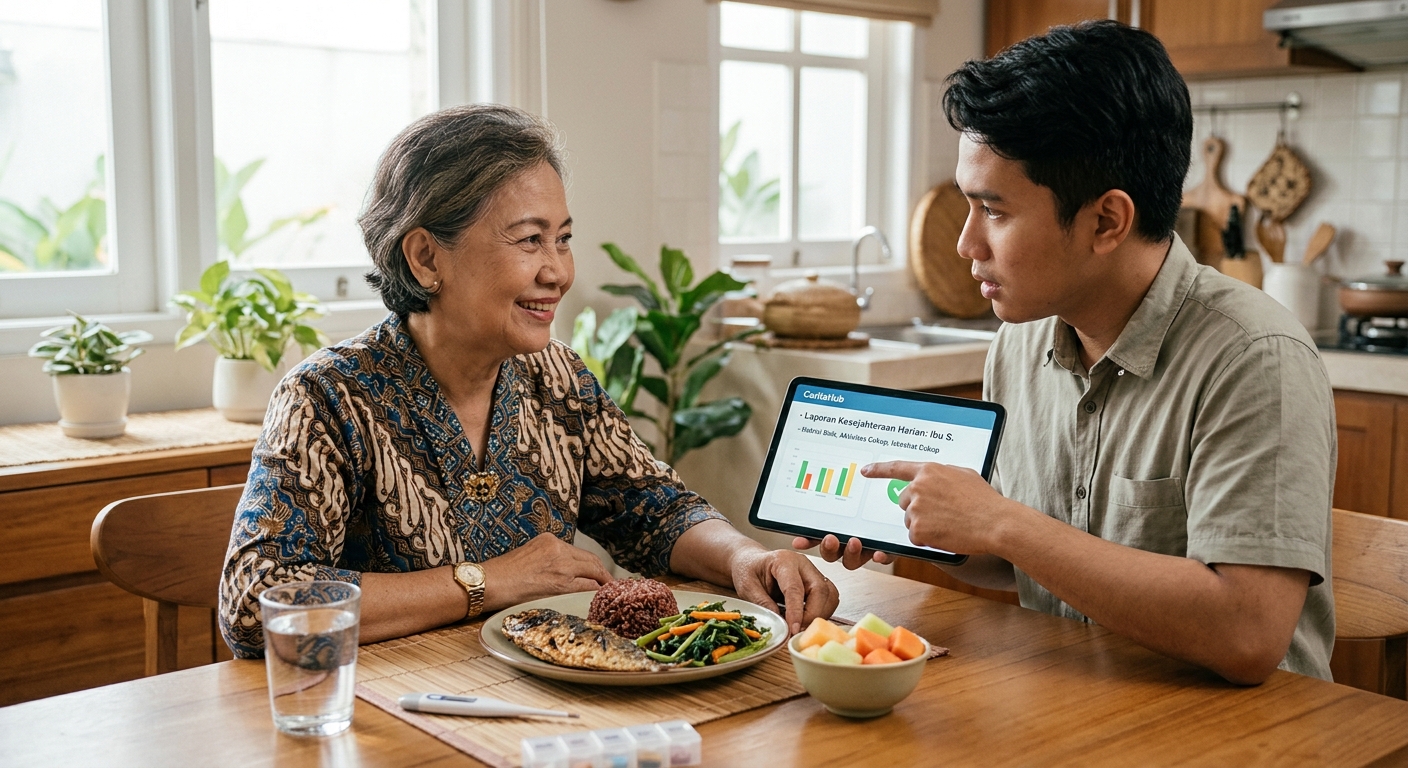
Through Caring Voice, CaritaHub's AI voice companion, a senior can receive a short, warm call each day that includes simple, low-pressure questions about how she's doing — questions that can just as easily cover whether she's eaten, how her appetite has been, or whether anything feels different, alongside the reminders and check-ins the call is already built around. It's not a clinical interrogation; it's closer to the kind of gentle daily question a caring neighbour might ask. Because the call happens every day rather than occasionally, small shifts — a senior mentioning she "hasn't felt much like eating lately," or skipping the call's food-related question three days in a row — become visible as a pattern rather than disappearing as a one-off comment nobody had the full context to notice.
Those patterns don't get quietly buried in a call log either. When something looks like it's changed — appetite, mood, energy — it's flagged for a real person on the care team to review and follow up on, whether that's a family caregiver, a community kader, or a case worker, depending on the setting. The system doesn't diagnose anything, and it never should; identifying that something has changed, and making sure a human actually sees it, is the job it's built to do well.
For families using CaritaHub's broader platform, this fits into a wider picture of daily wellbeing that goes beyond nutrition alone — sitting alongside physical activity, medication reminders, cognitive engagement, and social connection as part of a more complete, ongoing view of how a senior is actually doing, rather than a single snapshot taken once every few weeks.
An Illustrative Example
Consider an elderly woman who lives alone, whose daughter checks in by phone most evenings but works full-time and lives across town. For weeks, phone calls go the same way: "Did you eat, Ma?" "Yes, yes, I ate." Nothing about that exchange sounds alarming — until a routine health check-up shows unexpected weight loss.
In a version of that same story supported by daily wellness check-ins, a pattern quietly starts to form well before that check-up: several days of lower appetite, mentioned almost in passing, each one small enough to seem unremarkable on its own. Flagged and reviewed together, though, that pattern becomes something worth a conversation — a kader visit, a nudge to see a doctor, a gentle check from her daughter that goes beyond "did you eat" to "what did you have for lunch today, and how did it taste to you?" It's a small shift in awareness, but often an early one, which is usually the difference that matters most.
Nutrition Is Part of a Bigger Picture
It's worth being honest about what nutrition tracking can and can't do. It isn't a diagnosis, and it isn't a substitute for regular medical care — a consistent pattern of reduced appetite deserves an actual doctor's attention, not just an app's flag. What daily, consistent check-ins can offer is something more modest but genuinely valuable: the chance for a change to be noticed in days rather than months, and for that noticing to reach a real person who can act on it, rather than dissolving into a string of well-meaning but ultimately uninformative "did you eat?" phone calls.
For Indonesia and Singapore's rapidly aging populations, that kind of quiet, consistent attention to something as fundamental as nutrition may not make headlines, but it's often exactly the kind of care that keeps a senior healthy, independent, and at home for longer — which, in the end, is the whole point.