
Inside Malaysia's Long-Term Plan for an Ageing Nation: What the Data Shows
This article has not been translated yet, so it is shown in English.
Most people have heard the headline by now: Malaysia is becoming an "ageing nation." It's easy to read that as a looming deadline — a clock the country is racing against. The more accurate picture is less dramatic and more interesting: Malaysia has been deliberately building toward this moment for thirty years, through policy, infrastructure, and funding decisions made well in advance. The real story isn't urgency. It's what a long-term strategy still needs to account for, and the data offers some answers that rarely make it into the conversation.
A Three-Decade Plan, Not a Sudden Shift
Malaysia's policy response to population ageing didn't start recently, and it didn't start reactively. The country's first national elderly policy, Dasar Warga Tua Negara, dates to 1995. It was revised and renamed Dasar Warga Emas Negara (DWEN) in 2011, with a clear stated purpose: empowering individuals, families, and communities through age-friendly support and environments.
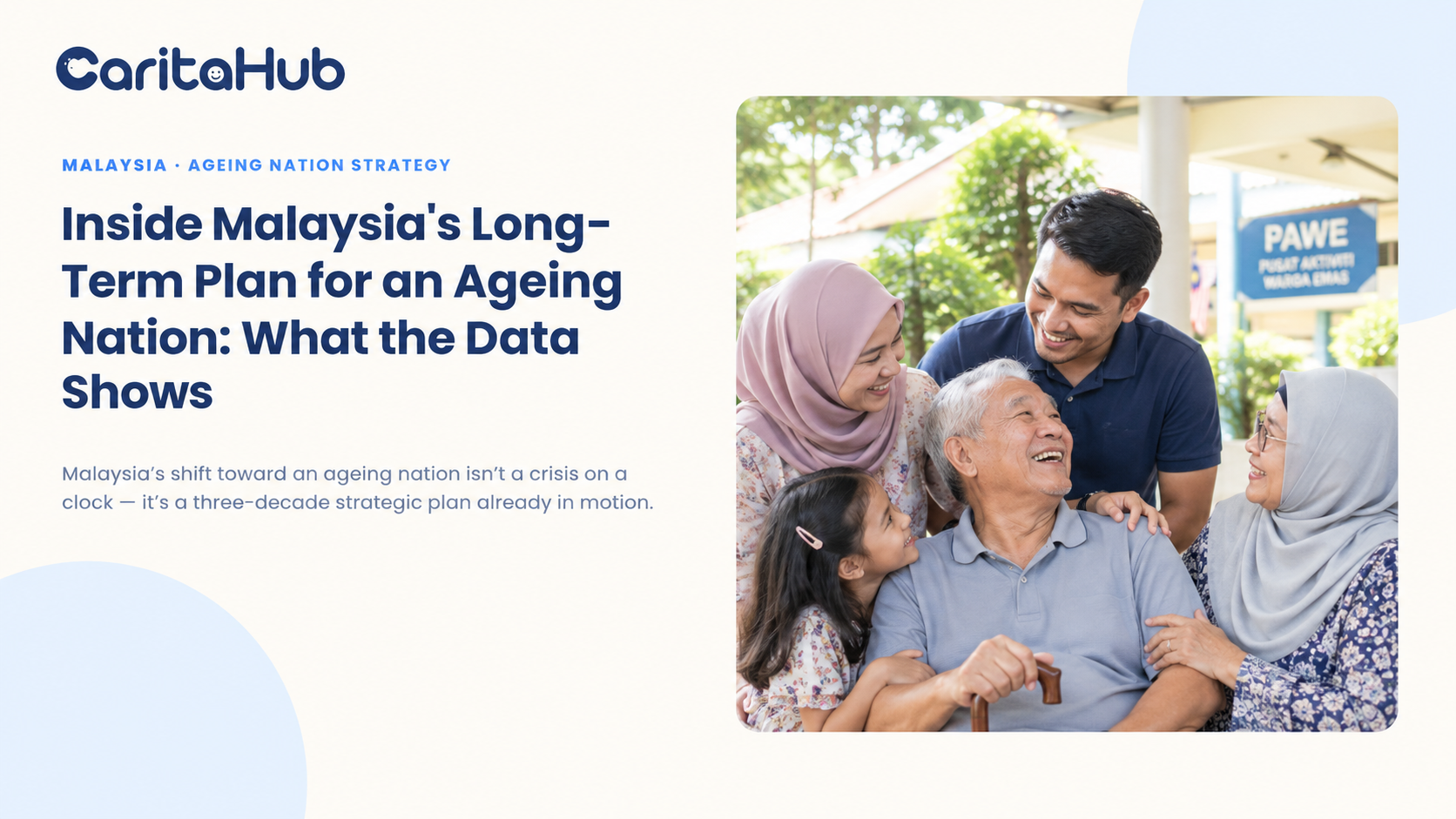
PAWE (Pusat Aktiviti Warga Emas), Malaysia's network of Senior Citizens Activity Centres, was established under that policy. Today, under the government's "1 Parlimen 1 PAWE" initiative, the country is building toward one centre per parliamentary constituency — a target of 222 nationwide, with more than 200 already operating. The next chapter is already being drafted alongside the current one: a forthcoming National Ageing Blueprint, expected to accompany the 13th Malaysia Plan, is being shaped right now, even as today's plan is still being carried out.
This is what a genuine long-term strategy looks like in practice — not a single policy announcement, but three decades of layered, compounding decisions, each one informed by the last.
Two Different Benchmarks, Not One
One detail that's easy to miss in this planning picture: Malaysia is actually tracking its progress against two different benchmarks, not one, and they tell slightly different parts of the story.
By the United Nations' international convention — the share of the population aged 65 and above — Malaysia already crossed the ageing-nation threshold in 2022. Malaysia's own domestic policy, however, tracks a different age band: 60 and above, in line with the National Policy for Older Persons. By that measure, the country is heading toward 15.3% of the population in this age group by 2030, up from 7.9% in 2010 — the benchmark Malaysian welfare agencies themselves use as their own planning marker.
Read together, this isn't a contradiction — it's two instruments measuring the same long-term curve from different angles, both useful for different parts of the planning process: one for international comparison, one for domestic budgeting and infrastructure targets.
What the Strategy Still Needs to Account For
A thirty-year policy foundation is a strong starting point, but strategy is only as good as the data it's built on. Three specific, lesser-discussed figures from Malaysia's own national health data show where the next phase of planning has real work to do.
Falls. According to the National Health and Morbidity Survey (NHMS) 2018, roughly 15% of Malaysians aged 60 and above reported at least one fall in the preceding 12 months — a national figure covering the general community. Inside institutional settings specifically, the picture changes sharply: studies in Kuala Lumpur have found fall prevalence between 24% and 40%, roughly 1.5 to 2.5 times the community rate. For a national strategy built partly around expanding institutional and community-centre capacity, this gap is a planning input worth taking seriously — more centres and more beds only help if supervision quality scales with them.
Malnutrition. The same national survey found that 7.3% of Malaysian seniors were malnourished, with a further 23.5% at risk — together, nearly a third of all older Malaysians nationally. In institutional and hospitalised-elderly studies specifically, some Malaysian research has reported malnutrition prevalence as high as 55%. Malnutrition rarely looks dramatic in its early stages. It looks like a plate that isn't quite finished, noticed only by whoever happens to be present at mealtime — which means it can progress for months, unnoticed, without a consistent way of tracking it.
Isolation and depression. A national survey found that 49.8% of older Malaysians are at risk of social isolation — essentially one in two. Separately, NHMS 2018 found 11.2% of Malaysian elderly screened positive for depressive symptoms. Isolation compounds every other risk on this list: an isolated senior is also less likely to be noticed if a fall happens, a meal is skipped, or a health decline sets in.
What ties these three figures together isn't that Malaysia's elderly population is unusually frail. It's that all three risks are, by nature, quiet. They don't announce themselves the way a medical emergency does — which is exactly why they're the kind of thing a well-designed long-term system needs to be built to catch, rather than something families alone can be expected to monitor indefinitely.
The Family Model Behind the Plan
For a long time, the implicit assumption behind elderly care policy in Malaysia — and across much of Asia — was that families would absorb most of the day-to-day burden, with government infrastructure filling the gaps. A 2014 national survey found that 79.6% of older Malaysians depended on their children for day-to-day support, and that assumption still underpins a great deal of policy thinking today.
The structural conditions behind that model are shifting, though, in ways worth building into the next planning cycle. Malaysian households are smaller than they were a generation ago. Adult children increasingly live and work in different cities, sometimes different countries, from their ageing parents. The same daughter who might have lived down the street from her mother in 1995 may now be managing that relationship from several hours away, fitting check-in calls between her own job and her own children's school pickup.
This isn't a story about families caring less. It's a planning variable: the model that elderly policy was built around is changing faster than many assume, and a long-term strategy needs to design for that shift rather than around it.
What's Already Being Shown to Work
A thirty-year policy foundation doesn't need to start from zero when it comes to execution, either. Across the region, some of the same risks documented in Malaysia's own health surveys — falls, nutritional decline, isolation — are already being addressed at meaningful scale by dedicated care-coordination platforms, offering a useful reference point for what the next phase of planning could draw on.
CaritaHub, a senior-care platform built by Weeswares, is one instructive example of what a structural answer to these specific problems looks like in practice. In Singapore, the platform now runs across more than 90 Active Ageing Centres — close to 40% of the country's national network — and is certified compatible with Singapore's national Active Ageing Centre IT standard, meaning its adoption there has been independently verified against a government framework, not just self-reported.
The way it addresses the three risks outlined above is specific rather than generic. For falls, a wearable device called CaritaPal combines fall detection with an SOS function, so an incident is flagged the moment it happens rather than at the next scheduled check — developed through collaboration with Tzu Chi Foundation specifically around proactive risk-flagging for at-risk seniors. For the kind of gradual decline that leads to malnutrition, routine daily check-ins — not special assessments, just an ordinary part of the day — log simple wellbeing and vital signs, so a downward trend becomes visible in a record over weeks. For isolation, a dedicated family and caregiver app gives relatives real visit notes and updates without needing to place a phone call, while community and volunteer engagement features keep a senior socially connected between family visits.
Underpinning all of it is a philosophy that's easy to state and harder to build correctly: the system prompts, and a person decides. Every flag the platform raises — a missed session, a concerning reading — goes to a named coordinator, who decides whether to act or dismiss it, logged with a name and a time. For a planning environment where public trust in any new system matters as much as its technical capability, that distinction between software that assists and software that decides isn't a minor detail — it's close to the whole point.
A Strategy Measured in Decades, Not Deadlines
It's tempting to read statistics like these as reasons to panic. They're better read as planning inputs — the kind of specific, grounded data that turns a thirty-year policy commitment into a strategy that actually matches how ageing is unfolding on the ground, rather than how it was assumed to unfold when the first policy was written in 1995.
Malaysia's journey toward becoming an ageing nation — by whichever benchmark is used — isn't a countdown. It's a long-running, still-evolving plan, and the institutions, budgets, and platforms responding to it are all part of refining it as new evidence comes in. But refining a national strategy and noticing one's own parent are not the same task, and no policy document replaces the second one. Asking a parent how they're really doing, and listening past the first reassuring answer, remains one of the few things no plan can fully substitute for.