
Teman Usaha: Building a Business Companion for Indonesia's Elderly Entrepreneurs
This article has not been translated yet, so it is shown in English.
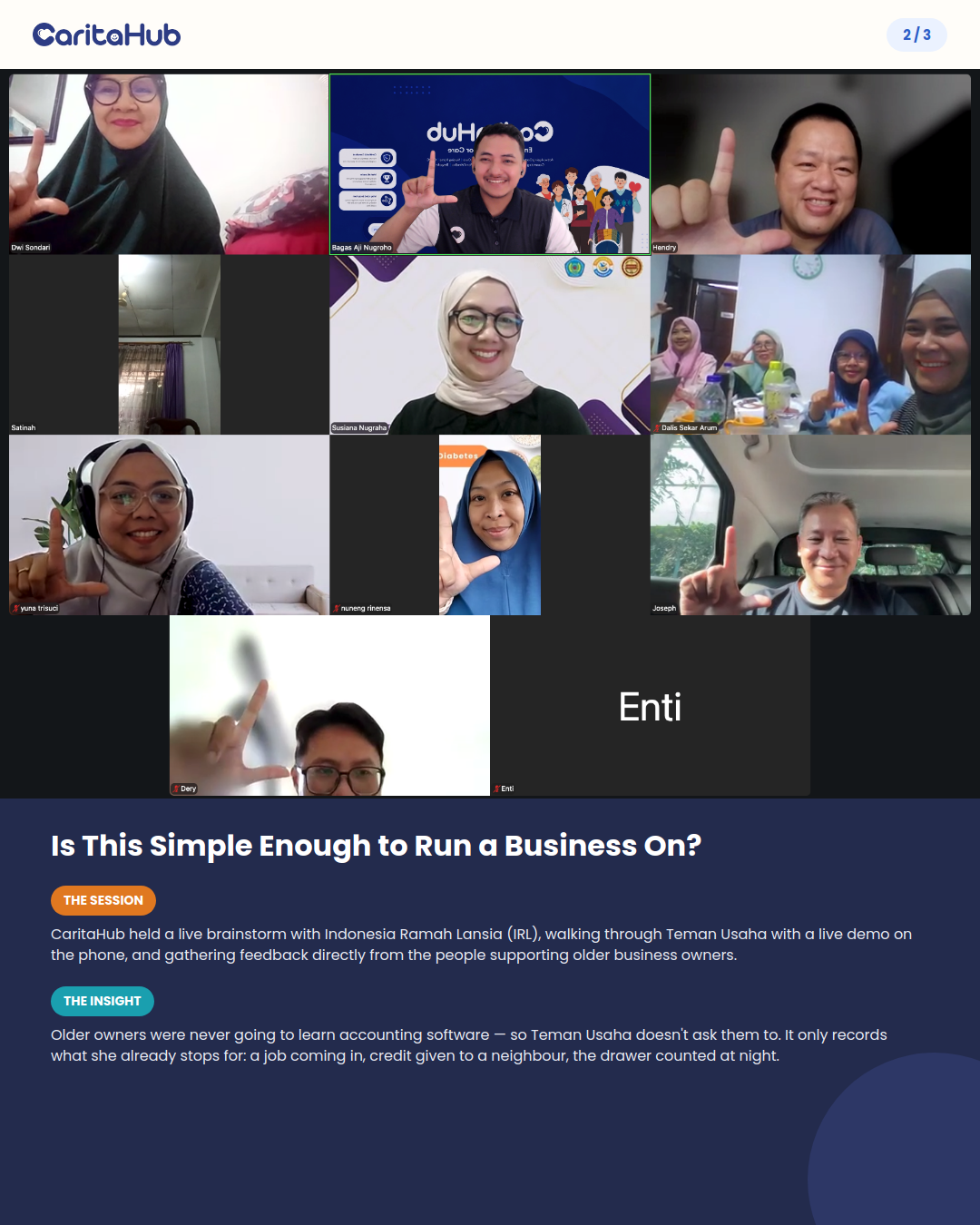
There is a question that sits at the heart of a lot of well-intentioned technology built for older people: is it actually simple enough for them to use? It's a question easy to ask in a pitch deck and much harder to answer honestly. It was also the exact question CaritaHub and Indonesia Ramah Lansia (IRL) set out to answer together in a virtual brainstorm session held on Wednesday, 16 September 2026 — not with a finished product demanding approval, but with a working prototype, a live demo, and a genuine invitation for IRL to push back.
The subject of that session was Teman Usaha — literally, "business companion" — a tool built for a group of entrepreneurs who are often talked about in policy documents but rarely designed for directly: older Indonesians who have been running a small business, often for decades, without ever needing to open a spreadsheet.
The Problem, in One Line
Every product needs a reason to exist, and Teman Usaha's is refreshingly blunt: older owners were never going to learn accounting software. Not because they lack the capability, but because after forty years of sewing, selling, or teaching, nobody ever counted the hours, priced the labor, or typed a single sale into a screen — and no app was ever going to change that habit by asking nicely.
Instead, three very ordinary problems keep showing up in the daily life of an older business owner. Asking a neighbour for money owed costs more socially than the debt is worth, so the kasbon notebook quietly grows unpaid. Stock piles up in a corner with only a fuzzy memory of whose is whose. And after forty years of sewing, nobody has ever actually counted what an hour of that labor is worth. None of these are accounting problems. They're questions about dignity, memory, and fairness — and that reframing shaped everything that came after it.
Who It's Actually For
Teman Usaha is not trying to be the next small-business super-app. It is built, deliberately and narrowly, for older owners running small businesses — not larger operations with branches, shifts, or staff to manage. The idea underneath the product is simple: an older owner doesn't run "a business" in the abstract. She runs one or two familiar shapes of work she already knows by heart, and everything else should stay quietly out of her way.
In practice, that means the app only records where she already naturally stops during her day: taking in a job, giving credit to a regular customer, paying a supplier, counting the cash drawer before bed. There is no sales screen demanding she type up every transaction one by one — what a shop sells is simply inferred from what it buys and pays out, which mirrors how she already thinks about her own business. Her numbers and her answers stay hers; nothing about her personal income or wellbeing leaves her own shop's records. And she is never expected to figure any of this out alone — a pendamping or community kader is enrolled alongside her from day one, named in every help screen, one step away if she gets stuck.
Four Kinds of Work, Not Forty Business Types
One of the more elegant design decisions behind Teman Usaha is its refusal to treat every small business as a unique problem to solve. Instead, the team observed that almost every small business an older Indonesian runs falls into one of four familiar shapes: Kelas (classes, tutoring, or care sessions), Servis & perbaikan (repairs, tailoring, laundry), Toko & kasbon (a shop or stall running on cash and informal credit), and Pesanan (food, craft, or made-to-order work).
An owner simply switches on the one or two shapes she actually does — most need only one — while everything else stays invisible. Underneath, a shared foundation handles the things every business has in common: customers, credit given, money paid out, the evening cash count, and a simple weekly summary. It's a quietly effective piece of design logic: instead of forcing one generic tool to fit every kind of work, the product assumes most of the answer already exists in how these businesses actually run, and simply gets out of the way of the rest.
A Deliberately Small Ask
If there is a single design principle running through Teman Usaha, it's restraint. The team's own internal comparison made the point vividly: a version of the app built for an owner doing all four kinds of work has about fourteen things to tap on her home screen. A version built for a bicycle repair shop that only does one kind of work — the actual, common case — cuts that down to around ten. It's a small difference on paper, but for someone who has never needed to learn an app before, it's often the difference between something she'll actually open again tomorrow and something she quietly gives up on.
That same instinct for restraint shows up in how the app checks in on wellbeing. A short, optional question appears after the evening cash count — Berat, Biasa, Ringan, or simply skip it — and skipping writes nothing at all. Nothing about her mood is shared with anyone unless she explicitly chooses to share it with her kader. It never diagnoses, never infers meaning from silence, and always routes anything that does need a human response to an actual person, not an automated reply. Care, in other words, is offered — never imposed.
Why This Matters: The Numbers Behind the Design
It would be easy to read Teman Usaha as a small, niche tool for a small, niche group. The numbers say otherwise. According to Indonesia's Central Statistics Agency (BPS, August 2023), roughly 11.4 million Indonesians aged 60 and above already run their own business — close to one in five of all entrepreneurs nationwide, making older Indonesians the single largest age group in the country's entire entrepreneurial population.
That statistic reframes the entire project. This isn't a side feature for a handful of elderly hobbyists — it's a genuine attempt to build for the largest, and often least visible, segment of Indonesia's small business economy. Every warung, every home tailor, every neighbourhood tutor run by someone in their sixties, seventies, or eighties represents both a livelihood and, quietly, a piece of Indonesia's informal economic backbone that has rarely had technology built around its actual habits rather than around what a younger, more digitally fluent user might expect.
Built With, Not Just For
What distinguished this particular session from a typical product demo was the posture CaritaHub brought into the room. Rather than presenting Teman Usaha as a finished answer, the ninety-minute session was structured explicitly around four open questions the team wanted to work through together with IRL: Who is this really for — only the smallest businesses, or bigger ones too, and who helps an owner get started? How should the app handle money — cash-first with one evening total, or push toward QRIS adoption? How do you check on someone's wellbeing without it starting to feel like being watched? And, bluntly: is it simple enough, or are there still buttons and names on screen that would confuse the very people it's built for?
These aren't rhetorical questions asked for show. They shape real product decisions — which features ship, which get simplified further, and which get removed entirely. Bringing that decision-making process into the room with the people closest to Indonesia's older business owners, rather than making those calls in isolation, is itself a meaningful design choice, and one CaritaHub was explicit about wanting to repeat.
What Comes Next
The session closed not with a final product but with a shared list of decisions still to make: how narrowly to define who the pilot is for, how to handle the cash-versus-QRIS question, what a respectful wellness check-in should look like at scale, and which parts of the interface still need simplifying or renaming before real owners see them. That list, if anything, is the more honest outcome of a genuine co-design process — a set of open questions carried forward with real stakeholders, rather than a polished announcement asking only for applause.
For CaritaHub, this reflects a broader pattern in how the company approaches new markets: build a working prototype first, then bring it into the room with the people who understand the daily reality of the users it's meant to serve, and let that conversation reshape the product before it reaches a single real customer. It's a slower way to build. It also tends to produce something that actually gets used.
Looking Ahead
Indonesia's elderly business owners have, for the most part, never been the target audience of a purpose-built piece of software — not because they don't run real businesses, but because most tools assume a user who is comfortable typing every transaction into a screen and reading through a dozen menu options to find what they need. Teman Usaha starts from the opposite assumption: that the business already works, that the owner already knows how to run it, and that the only job left for technology is to quietly stay out of the way except at the handful of moments each day when a little help is genuinely useful.
With around 11.4 million elderly entrepreneurs already running businesses of their own across Indonesia, getting that balance right isn't a small design challenge — it's a meaningful one. CaritaHub's collaboration with Indonesia Ramah Lansia is one step toward getting there, built not around a finished pitch, but around a genuine, ongoing conversation with the people who will actually decide whether it works.