
Three Days at Booth S1: What Malaysia's Care Operators Actually Wanted to Talk About
This article has not been translated yet, so it is shown in English.
Nobody walked up to our booth and asked about software architecture.
They asked about Puan Siti, who stopped coming to the activity centre three weeks ago and nobody noticed. They asked about the daughter who calls every evening at six, right when the staff are serving dinner. They asked about the JKM report due on Friday that somebody has to assemble from an attendance book, a WhatsApp group and two spreadsheets.
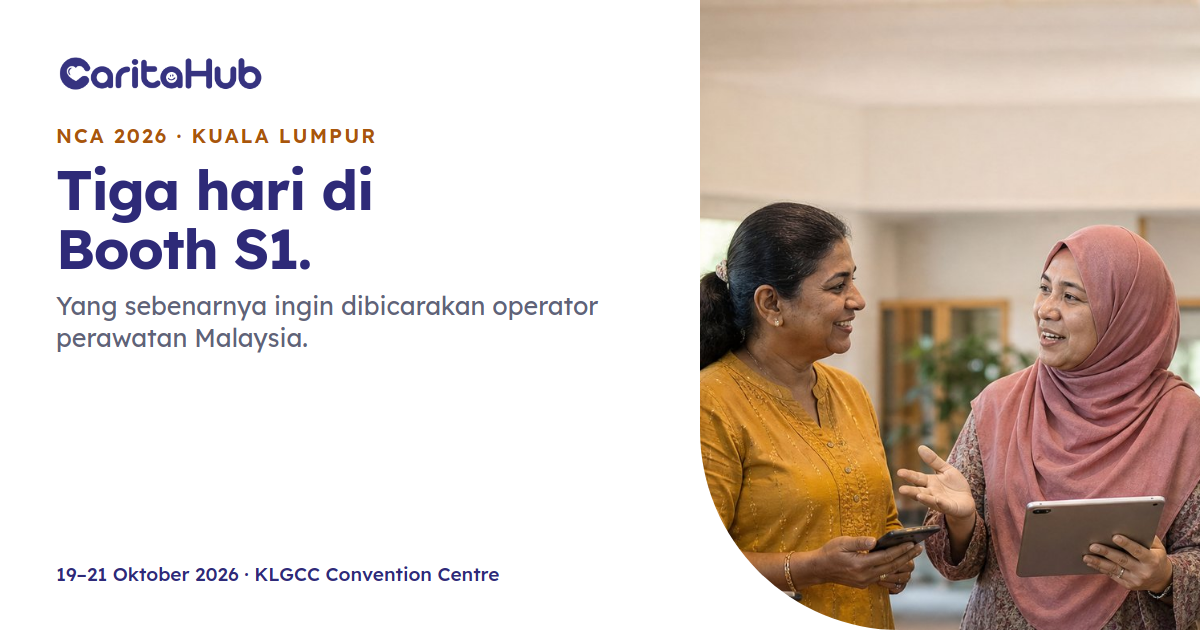
That was NCA 2026 for us: three days at Booth S1 in Ballroom 1–2 of KLGCC Convention Centre, 19 to 21 October, plus a short session in the Dining Room on the opening day. Here is what we heard, what we showed, and what is still open.
The week had a number hanging over it
Twelve states in Malaysia were officially ageing in 2025. Perak leads at 10.3% of residents aged 65 and above. By 2048, DOSM projects the whole country will be an aged nation, with 14% of residents 65 or older.
And this one, which came up again and again: 18.8% of older Malaysians live alone, according to NHMS 2025. Nearly one in five.
Statistics like these usually stay on conference slides. At our booth they had faces. The people standing in front of us run the activity centres that are filling up, the day care centres with waiting lists, the nursing homes where one supervisor stretches across several shifts. They are not waiting for 2048. They are already there.
"Her record stops at my door"
This was the conversation that repeated most.
A woman joins an activity centre. Months later she starts day care twice a week. Then a carer begins visiting her at home. One day she may need a nursing home. Four services, four teams, four sets of paperwork, and almost nothing travels with her.
So the next team starts from a blank page. New form. New phone call to the family. New notes. Years of knowing this person, gone.
One operator put the cost simply: the small signs are what get lost. She is eating less. She has stopped joining the Tuesday group. She seems quieter since the hospital. Those are the things a team notices over time, and they are exactly the things that do not survive a handover.
What we put on the screen was the opposite: one record she carries with her, with her consent, so the next team opens years of history instead of a blank form.
"The phone never stops"
Second thing we heard, at nearly every table.
Families call. They call at dinner time, during medication rounds, in the middle of a shower. Staff pick up, because of course they do.
Not one person we spoke to blamed the families. Think about the daughter working full time in another state. She has exactly one way to find out whether her mother ate lunch today: call a busy person and hope they are free.
On the demo screen, that whole loop disappeared. The family page shows today at the centre, or today's home visit summary. It opens only with consent, and only after the visit has been signed off.
Several operators said some version of the same sentence: if families could just see it, the phone would ring less and my staff could stay with the residents.
"Friday is report day"
And the third: reports for JKM and for sponsors, still built by hand at the end of every month.
Attendance books. Screenshots from a WhatsApp group. A spreadsheet somebody keeps on their own laptop. Hours of work to describe care that already happened and was already written down, just in five different places.
Our answer is not clever, it is just logical. If your staff and volunteers already record attendance, visits and notes as they happen, the monthly report should fall out of that record. Nobody should rebuild it from scratch.
For the compliance question that always follows: CaritaHub is built for Malaysia's PDPA and designed to sit alongside JKM systems, including eWargaEmas. With JKM's agreement, records can flow into eWargaEmas and e-Komuniti. And if you would rather keep everything in-house, it can run on a server inside your own organisation.
What the demo actually looked like
It changed depending on who was standing there. A PAWE coordinator and a nursing home matron do not have the same Tuesday.
- PAWE and activity centres: each volunteer sees their own call list on their phone. Members who stop coming get flagged for a check-in. PAWE 3A points at a mosque, surau or hall run from the same app.
- Day care: one tap in, one tap out at the door. Medication reminders. At home time, only people the family has authorised can collect her.
- Home care: visits planned as a series on one calendar. The carer checks in and out on their phone. A task not done needs a reason, so the coordinator sees every gap instead of guessing.
- Senior living and nursing homes: shift handover that says what happened and what is still due. Daily care tasks, done or not done, with a reason. Short stays for recovery after hospital. Incidents recorded, so records are ready when an inspector walks in.
Different modules, same record. The service changes around her. Her history does not restart.
The session: Malaysia is not short of services
On the opening day we took fifteen minutes in the Dining Room to make one argument, and only one.
Malaysia does not lack services for older people. It lacks continuity between them. And fixing that does not mean every operator has to buy the same software. It means the record moves with the person, with her consent, and the people around her see the same picture.
We brought some evidence. CaritaHub runs in more than 90 Active Ageing Centres in Singapore, roughly 40% of the country's total, handling about 10,000 check-ins a day, most of them at self-service kiosks. Over 200,000 seniors have been served on the platform. More than 15 partners in Indonesia have used it for elderly care since 2024, and Vietnam is in progress. Company figures, September 2026.
"Will the AI decide for my staff?"
Asked more than once, usually with a slightly wary face.
The answer is no, and it is built that way on purpose. AI notices who has not been seen in a while. It writes up a visit from a spoken note. It drafts the report for someone to check. Then it stops.
A person decides whether to visit, refer or close, and their name and the time are saved against that decision. Every priority list shows its reasons. Consent is recorded for voice and photos. CaritaHub coordinates care. It does not diagnose and it does not treat.
And the thing we said to everyone who asked: tell us which tools you want, and we will tell you straight which ones are live today and which are still in pilot.
Two or three partners for 2027, and the door is still open
We came to Kuala Lumpur looking for founding partners for pilots starting early 2027: an activity centre, a care operator, and a state programme. Those conversations started at the booth. None of them are closed.
Being a founding partner is not a discount scheme. You work with us through the first year, you shape how the platform fits the way care is actually done in Malaysia, and you talk to our team directly instead of filing a ticket and waiting.
A few researchers asked about evaluating the pilots with consented data. That door is open too.
Terima kasih
Thank you to the organisers of Malaysia Ageing & Long Term Care Week 2026, to the teams at the booths around us, and most of all to the operators, nurses, coordinators and volunteers who spent their coffee break talking to us instead of sitting down.
If the three stories above sound like your week, we would like to finish the conversation. Email hello@caritahub.com or visit www.caritahub.com. Tell us what you run and the one job that eats your week, and we will show you what it looks like on a single record.